











WASHINGTON D.C.
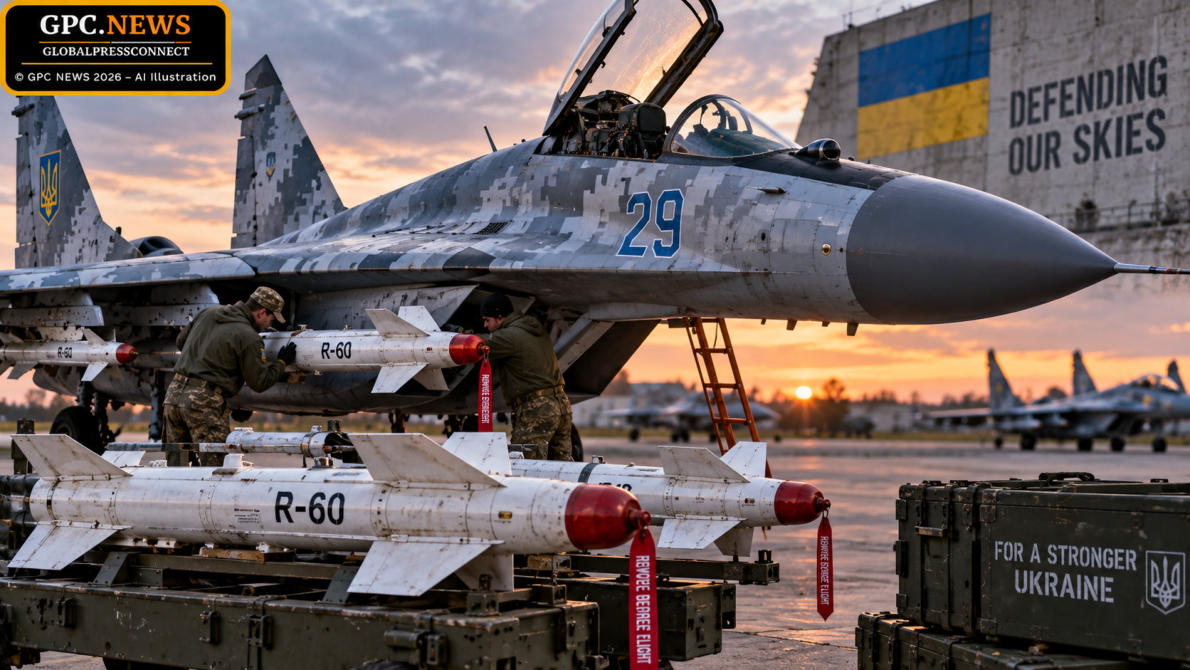
Global Press Connect provides independent news and analysis on international  politics, the economy, and humanitarian developments. © 2026 GlobalPressConnect | GPC.NEWS Founded and operated by Simone Mayer & Helping Hands for Children Foundation Inc. | Los Angeles, California, USA GlobalPressConnect (GPC.NEWS) is an independent international news organization dedicated to delivering accurate, impartial, and timely journalism. Our mission is to provide verified reporting, editorial integrity, and in-depth coverage of global affairs, politics, business, financial markets, technology & AI, entertainment, humanitarian issues, weather, and breaking news. All Rights Reserved. UKRAINE TURNS TO 1970s-ERA MISSILES AS MODERN INTERCEPTOR STOCKS RUN LOW    KYIV, September 7, 2026 — GPC.NEWS — Ukraine is increasingly turning to decades-old Soviet air-to-air weapons as pressure on its stocks of modern interceptor missiles continues to grow amid sustained Russian aerial attacks.  Ukrainian MiG-29 fighter aircraft have been observed carrying R-60 infrared-guided missiles, a weapon developed by the Soviet Union in the early 1970s and introduced into service more than five decades ago.  The renewed use of the R-60 illustrates the extraordinary logistical challenge facing Ukraine as its air force and ground-based air-defense units attempt to counter large numbers of Russian drones, cruise missiles and other aerial threats.  More modern missiles are considerably more capable, but firing expensive and increasingly scarce interceptors against comparatively inexpensive drones creates an unsustainable economic and logistical equation.  Ukraine has therefore adapted a wide range of older weapons and platforms to strengthen its layered air-defense network.  The MiG-29 remains an important component of Ukraine's fighter fleet despite the introduction of Western aircraft. Soviet-designed fighters can operate weapons already held in Ukrainian inventories and provide another option for intercepting slower aerial targets.  The R-60 was originally designed for short-range aerial combat rather than modern drone warfare. Its reappearance nevertheless demonstrates how weapons developed during the Cold War can acquire an entirely new role on a 21st-century battlefield.  Kyiv continues to appeal to Western partners for additional air-defense systems and interceptor missiles as Russia maintains pressure on Ukrainian cities, military installations and energy infrastructure.  With both sides increasingly relying on large numbers of drones, the cost of interception has become almost as important as the technical ability to destroy an incoming target.  For Ukraine, bringing older R-60 missiles back into operational use provides another potentially valuable layer of defense — while also highlighting the continuing strain on the country's more advanced missile inventories.  Sources: Ukrainian defense reporting, international media reports | GPC.NEWS